| Using a Nikon 600mm f/5.6 Manual Focus Camera Lens as a Telescope |
Disadvantages:
Weight, the lens is 6.2 pounds and the eyepiece
is 1.6 pounds.
The image is upside down, which I deal with by
making a close focus telescope.
The camera is set far back and to view and
focus the viewer for me, with short arms, is best
set at 45 degrees or 90 degrees. A sliding
balance bar is required to get correct balance.
Advantages:
Larger aperture giving 1 aperture stop faster
than an 80mm telescope. Aperture control all
the way to f/22, f/32 is possible but yields poor results.
No prism in the optical path.
The close focus viewer:
In an effort to find a way to focus my camera using a telescope without an erecting prism, I have made some progress in making a
small, close focusing telescope to view the LCD with. htttp://www.anchoroptics.com
From this company I purchased a couple of experimental grade lenses. The telescope objective consists of a 12.5mm focal length
triplet achromat as the field lens with 12mm focal length double convex lens mounted as close as possible behind the achromat without
touching. I mounted these in a 1.25 inch eyepiece extension tube and secured the elements by using rubber gromets, washers, and O
rings available at the local hardware store. This objective is mounted at the very bottom of a 1 inch tube. The eyepiece is a 40mm
Hastings triplet that I purchased from edmunds optics. It is mounted inside another 1 inch extension tube. By experimenting with
distances, I took a third one inch extension tube and reduced it to about 15mm which is placed in between the objective and
the eyepiece. The field lens is mounted about 35mm above the LCD. The eye relief is extraordinary, so I placed another 1 inch
extension behind the eyepiece. The entire length is five inches, and the weight is about 3 ounces. I tested this by placing an eyepiece on
a telephoto camera lens and using my Coolpix 8400 and Coolpix 4500. The weight of the viewer is too much for the 8400, so I made
a bracket to mount it at a 45 degree angle. The 4500 LCD is more substantial in construction, I can simply strap the viewer over the
LCD using a velcro strap.
Limitations:
There is some field curvature at the left and right edges of the
viewer, but not top to bottom.
There are no ED or HD elements, and there is some color aberration in
the red color range.
The most time consuming aspect of construction was experimenting with
distances between the elements to get the best focus. It is focused
for my eye corrected for distance. If I remove my glasses it is not
in focus at all. Viewing has to be straight.
In spite of these minor problems, it works, the image is recorded on
the camera upside down, but I can photograph with the image correctly
oriented in the viewer, and I can accurately manually focus with it.
I am able to view the entire LCD, and it is not overly magnified.
Weight, the lens is 6.2 pounds and the eyepiece
is 1.6 pounds.
The image is upside down, which I deal with by
making a close focus telescope.
The camera is set far back and to view and
focus the viewer for me, with short arms, is best
set at 45 degrees or 90 degrees. A sliding
balance bar is required to get correct balance.
Advantages:
Larger aperture giving 1 aperture stop faster
than an 80mm telescope. Aperture control all
the way to f/22, f/32 is possible but yields poor results.
No prism in the optical path.
The close focus viewer:
In an effort to find a way to focus my camera using a telescope without an erecting prism, I have made some progress in making a
small, close focusing telescope to view the LCD with. htttp://www.anchoroptics.com
From this company I purchased a couple of experimental grade lenses. The telescope objective consists of a 12.5mm focal length
triplet achromat as the field lens with 12mm focal length double convex lens mounted as close as possible behind the achromat without
touching. I mounted these in a 1.25 inch eyepiece extension tube and secured the elements by using rubber gromets, washers, and O
rings available at the local hardware store. This objective is mounted at the very bottom of a 1 inch tube. The eyepiece is a 40mm
Hastings triplet that I purchased from edmunds optics. It is mounted inside another 1 inch extension tube. By experimenting with
distances, I took a third one inch extension tube and reduced it to about 15mm which is placed in between the objective and
the eyepiece. The field lens is mounted about 35mm above the LCD. The eye relief is extraordinary, so I placed another 1 inch
extension behind the eyepiece. The entire length is five inches, and the weight is about 3 ounces. I tested this by placing an eyepiece on
a telephoto camera lens and using my Coolpix 8400 and Coolpix 4500. The weight of the viewer is too much for the 8400, so I made
a bracket to mount it at a 45 degree angle. The 4500 LCD is more substantial in construction, I can simply strap the viewer over the
LCD using a velcro strap.
Limitations:
There is some field curvature at the left and right edges of the
viewer, but not top to bottom.
There are no ED or HD elements, and there is some color aberration in
the red color range.
The most time consuming aspect of construction was experimenting with
distances between the elements to get the best focus. It is focused
for my eye corrected for distance. If I remove my glasses it is not
in focus at all. Viewing has to be straight.
In spite of these minor problems, it works, the image is recorded on
the camera upside down, but I can photograph with the image correctly
oriented in the viewer, and I can accurately manually focus with it.
I am able to view the entire LCD, and it is not overly magnified.
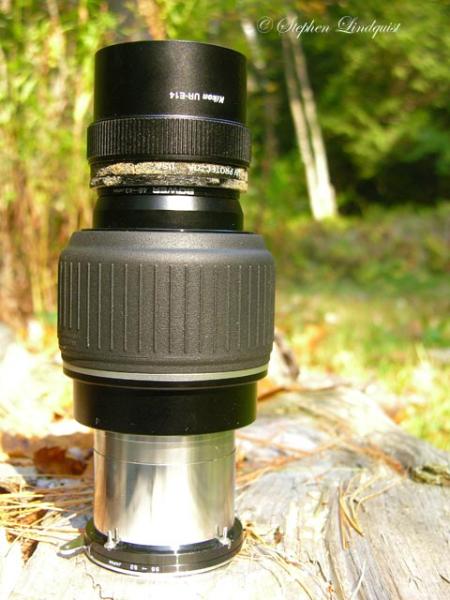
The top of the Pentax eyepiece
has 43mm threads, and I used a
combination to use either the
UR-E14 or UR-E15 and step
rings to easily mount the Coolpix
8400 camera.
In an effort to make the step rings
attached to the UR-E14 easier to
take off, I applied some plastic
cement to the outer surface and
rolled it in some fine sand. It helps
some, but step rings can be
difficult to take apart.